How to Lower Cholesterol with Food

Updated: 14 hours ago
If you have been told to lower your cholesterol, you may be wondering what to put on your plate. Does it mean giving up all your favorite meals? Do you need special foods or expensive supplements?
A useful starting point is to eat less saturated fat and more fiber-rich whole plant foods. You can do that with familiar ingredients such as oats, beans, lentils, vegetables, and fruit.
In a review of 30 randomized trials, vegetarian and vegan diets lowered LDL cholesterol by an average of about 12 mg/dL (0.30 mmol/L) compared with omnivorous diets [1]. Results varied, and the studies tested different dietary patterns. That average is a guide to what food changes can achieve, not a promise about your own results.
This article focuses on lowering LDL, often called “bad” cholesterol. If you are unsure why yours is high, start with “Why Is Your Cholesterol High?”
Start with What You Replace
Butter, cream, cheese, fatty meats, coconut oil, and palm oil are common sources of saturated fat. Replacing saturated fat with unsaturated fat generally lowers LDL [2]. Many animal-derived foods also contain dietary cholesterol, which can raise LDL to varying degrees [3].
For a whole-food, plant-based approach, build meals around beans, lentils, tofu, whole grains, vegetables, and fruit. You can make satisfying meals without relying on added oils or coconut-based substitutes.
Try these swaps:
Replace fatty meat in a stew or pasta sauce with lentils, beans, or tofu.
Have oatmeal with fruit more often than a buttery breakfast pastry.
Make a bean-and-vegetable soup instead of a cream-based soup.
Use blended white beans to add body to soups and sauces.
Vegan cheeses and desserts can still be high in saturated fat, especially when made with coconut oil. Check the label rather than relying on the word “vegan.”

Make Soluble Fiber a Daily Habit
Some types of soluble fiber form a gel in the digestive tract and help reduce the reabsorption of bile acids. Your liver then uses cholesterol to replace those bile acids, helping lower LDL. In other words, soluble fiber acts like a sponge in your digestive tract to soak up cholesterol and flush it out of your body.
Here is how the process works in three simple steps:
Traps bile: Your liver uses cholesterol to make "bile" (a fluid that helps digest food). Soluble fiber turns into a thick gel in your gut, trapping this bile and pulling it out of your body through your waste.
Forces the liver to reset: Because the old bile was flushed away, your liver is forced to make brand-new bile.
Clears the bloodstream: To make this new bile, the liver acts like a vacuum cleaner, sucking "bad" (LDL) cholesterol out of your blood to use as raw material.
As a bonus, good bacteria in your gut eat the fiber and release healthy compounds that signal your liver to stop producing extra cholesterol in the first place.
A large review of randomized trials found that soluble-fiber supplements lowered LDL [4]. Those results support the usefulness of soluble fiber, but they do not mean you need to start with a supplement. Everyday foods can help you add more.

Oats and Barley
Oats and barley contain beta-glucan, a type of soluble fiber. Make them regular ingredients rather than occasional additions.
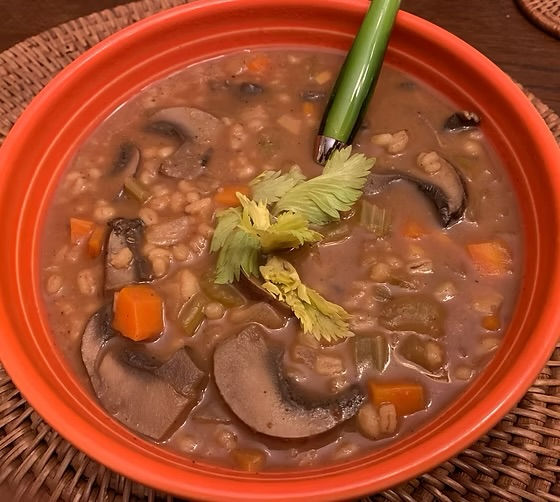
Try oatmeal topped with berries or chopped apple, overnight oats with unsweetened soy milk, or barley added to a vegetable soup. My mushroom barley soup is one way to put this into practice.
Beans and Lentils
Beans, chickpeas, lentils, and split peas provide fiber and plant protein. A review of 26 randomized trials found that diets emphasizing these foods lowered LDL compared with control diets [5].
Add chickpeas to a salad, use lentils in a tomato sauce, or make a pot of split-pea soup. If you are not used to eating beans, begin with a small portion and increase gradually as your digestion adjusts.
Fruit and vegetables belong alongside these foods. Apples, citrus fruit, carrots, and many other plant foods contribute fiber and variety. You do not need one special “cholesterol-lowering” food at every meal.
Give Soy Foods a Place on Your Plate
Tofu, tempeh, edamame, and unsweetened soy milk offer practical ways to include soy protein.
A meta-analysis of 46 trials found a small average LDL reduction with soy protein compared with non-soy protein [6]. Soy foods can also replace foods higher in saturated fat.
Try crumbled tofu in a breakfast scramble, edamame in a grain bowl, or baked tofu in a vegetable dish. Try different soy foods to find the ones you enjoy.
Add Ground Flaxseed
Ground flaxseed is an easy addition to oatmeal, unsweetened plant yogurt, or a smoothie. It provides fiber, lignans—naturally occurring plant compounds—and the plant omega-3 fat ALA.
A review of randomized trials found that whole-flaxseed preparations lowered LDL, while flaxseed oil did not show the same benefit [7].
Try stirring a spoonful of ground flaxseed into your breakfast. Ground seed retains the fiber that the oil lacks.
The amount used and the results varied between studies, so think of it as one useful food within the overall pattern rather than a guaranteed treatment.
Combine Helpful Foods
You may have heard of the “Portfolio” diet. It combines several cholesterol-lowering components, including viscous fiber, soy protein, nuts, and plant sterols.
In a six-month randomized trial, participants given Portfolio diet advice lowered LDL by about 13–14%, compared with about 3% in the group given standard low-saturated-fat advice [8].
That trial tested the combination, not each ingredient separately. These foods can help lower LDL, but you cannot simply add up results from separate studies to predict how much your own cholesterol will drop. It does show why the overall dietary pattern deserves attention.
What Could a Day Look Like?
These are meal ideas, not a prescribed menu or a guarantee of a particular LDL reduction:
Breakfast: Oatmeal with berries, chopped apple, and ground flaxseed.
Lunch: Lentil-and-vegetable soup with whole-grain bread.
Dinner: Brown rice with baked tofu, vegetables, and an oil-free lemon-herb dressing.
If you want a snack: Fresh fruit, vegetables with hummus, or edamame.
Choose meals you enjoy and can repeat. Familiar recipes often need only a few changes, such as replacing meat with lentils or making a soup creamy with blended beans.
What Results Can You Expect?
Your response depends on your starting diet, how much it changes, genetics, medical conditions, and any medication you take [9]. Someone already eating a diet low in saturated fat may see a different change from someone replacing daily butter, cheese, and fatty meat.
Many feeding trials detect changes within weeks, but maintaining the pattern matters [1,6]. Arrange follow-up blood testing with your healthcare professional to see how your own body responds.
Food changes can help even when you also need medication. Do not stop prescribed treatment because you have improved your diet; review your results and treatment together with your prescriber.
Start with Your Next Meal
You do not need to overhaul your kitchen overnight. Choose one or two changes: make oatmeal for breakfast, add beans to lunch, or try a lentil dish for dinner.
Keep the focus on what you eat regularly. A pattern of fiber-rich whole plant foods and less saturated fat is more useful than searching for one ingredient that will do all the work.
References:
[1] Koch CA, Kjeldsen EW, Frikke-Schmidt R. Vegetarian or vegan diets and blood lipids: a meta-analysis of
randomized trials. Eur Heart J. 2023;44(28):2609–2622. doi:10.1093/eurheartj/ehad211.
[2] Mensink RP, Zock PL, Kester ADM, Katan MB. Effects of dietary fatty acids and carbohydrates on the ratio of
serum total to HDL cholesterol and on serum lipids and apolipoproteins: a meta-analysis of 60 controlled trials.
Am J Clin Nutr. 2003;77(5):1146–1155. doi:10.1093/ajcn/77.5.1146.
[3] Carson JAS, Lichtenstein AH, Anderson CAM, et al. Dietary Cholesterol and Cardiovascular Risk: A Science
Advisory From the American Heart Association. Circulation. 2020;141(3):e39–e53.
doi:10.1161/CIR.0000000000000743.
[4] Ghavami A, Ziaei R, Talebi S, et al. Soluble Fiber Supplementation and Serum Lipid Profile: A Systematic
Review and Dose-Response Meta-Analysis of Randomized Controlled Trials. Adv Nutr. 2023;14(3):465–474.
doi:10.1016/j.advnut.2023.01.005.
[5] Ha V, Sievenpiper JL, de Souza RJ, et al. Effect of dietary pulse intake on established therapeutic lipid
targets for cardiovascular risk reduction: a systematic review and meta-analysis of randomized controlled
trials. CMAJ. 2014;186(8):E252–E262. doi:10.1503/cmaj.131727.
[6] Blanco Mejia S, Messina M, Li SS, et al. A Meta-Analysis of 46 Studies Identified by the FDA Demonstrates
that Soy Protein Decreases Circulating LDL and Total Cholesterol Concentrations in Adults. J Nutr.
2019;149(6):968–981. doi:10.1093/jn/nxz020.
[7] Yang C, Xia H, Wan M, et al. Comparisons of the effects of different flaxseed products consumption on lipid
profiles, inflammatory cytokines and anthropometric indices in patients with dyslipidemia related diseases:
systematic review and a dose-response meta-analysis of randomized controlled trials. Nutr Metab (Lond).
2021;18(1):91. doi:10.1186/s12986-021-00619-3.
[8] Jenkins DJA, Jones PJH, Lamarche B, et al. Effect of a dietary portfolio of cholesterol-lowering foods given at
2 levels of intensity of dietary advice on serum lipids in hyperlipidemia: a randomized controlled trial. JAMA.
2011;306(8):831–839. doi:10.1001/jama.2011.1202.
[9] Feingold KR. Approach to the Patient with Dyslipidemia. Updated June 27, 2025. In: Endotext [Internet].
South Dartmouth (MA): MDText.com, Inc.; 2000–. Accessed October 28, 2026.


